
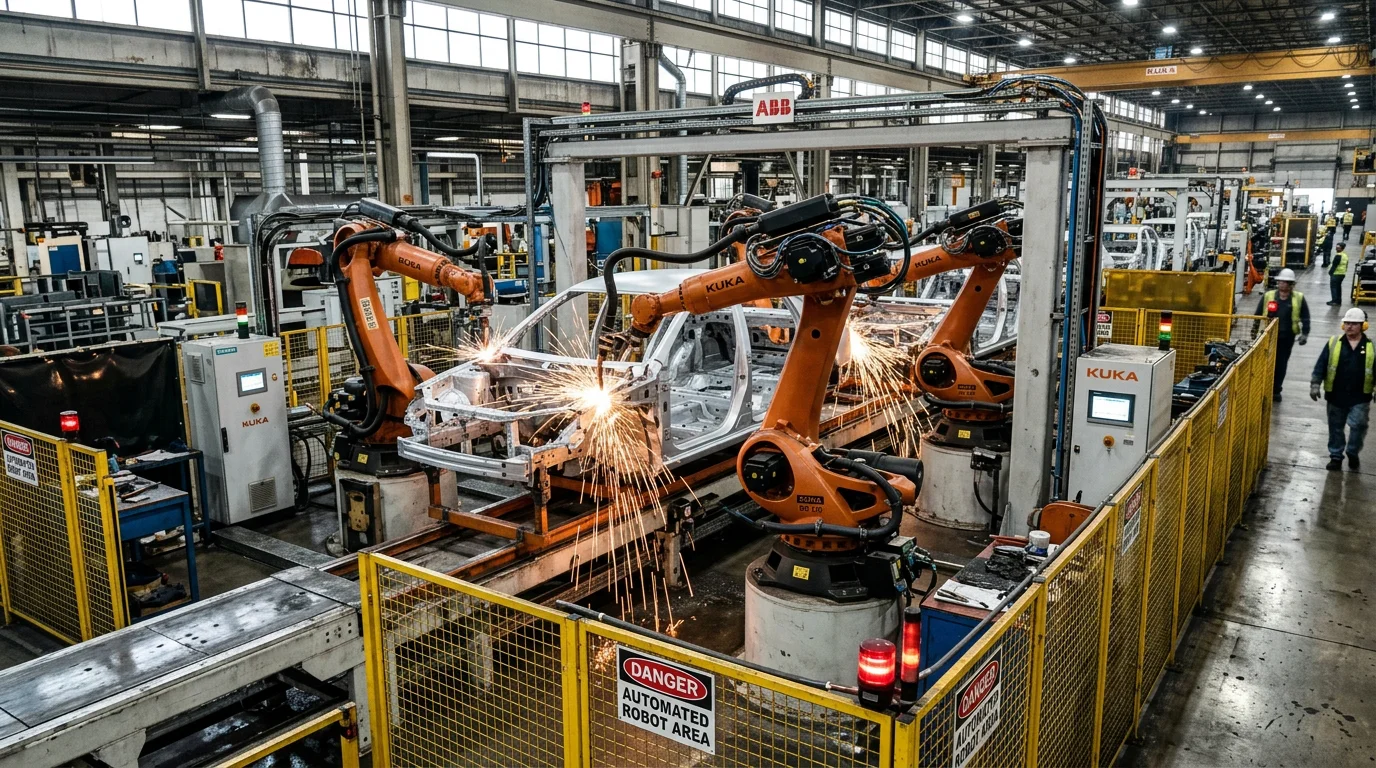
Selecting the right automation candidate begins not with robot catalogs, but with dissecting takt times, GD&T datum stability, operator ergonomics, and station failure modes.
Plant managers often ask: 'Which robot should we install on our line?' An experienced automation systems engineer begins with a very different set of questions: Where is the process bottleneck? Are the incoming component tolerances consistent enough for automated clamping? What is the failure mode when a part is out of spec?
Before investing in robotic cells or special-purpose machinery, evaluate these five critical criteria:
1. Cycle Time & Takt Alignment: Is the manual station holding back overall line velocity? If an operation requires consistent sub-45-second execution, automated indexing or robotic handling delivers predictable cadence that human operators cannot sustain over an 8-hour shift.
2. Mechanical Datum Integrity: Robots cannot adjust for warped or inconsistent parts without costly adaptive vision. Ensure the part has repeatable, stable datum surfaces for toggle clamps or pneumatic grippers.
3. Ergonomic Burden & Heavy Payloads: Any repetitive lift exceeding 15 kg or requiring awkward wrist torque is a prime candidate for pneumatic manipulators or robotic transfer to prevent musculoskeletal injuries.
4. Quality Defect Sensitivity: If a missed fastener, misaligned clip, or incomplete seal causes catastrophic downstream assembly teardown, inline Poka-Yoke sensors and automated vision inspection provide 100% verification.
5. Payback & Total Cost of Ownership: Factor in tooling changeover time, maintenance spare availability, and internal technician training alongside capital cost.
Draftdu works with manufacturing teams to perform comprehensive front-end engineering studies, ensuring automation investments deliver concrete, measurable ROI.
Have an engineering challenge on your shop floor?
Our systems engineering team can evaluate your line kinematics, clamp strategies, and station takt times.
Start a Technical Discussion ↗